
Protecting the Point of Entry
How airlocks and their valves work together in an NBC survival bunker
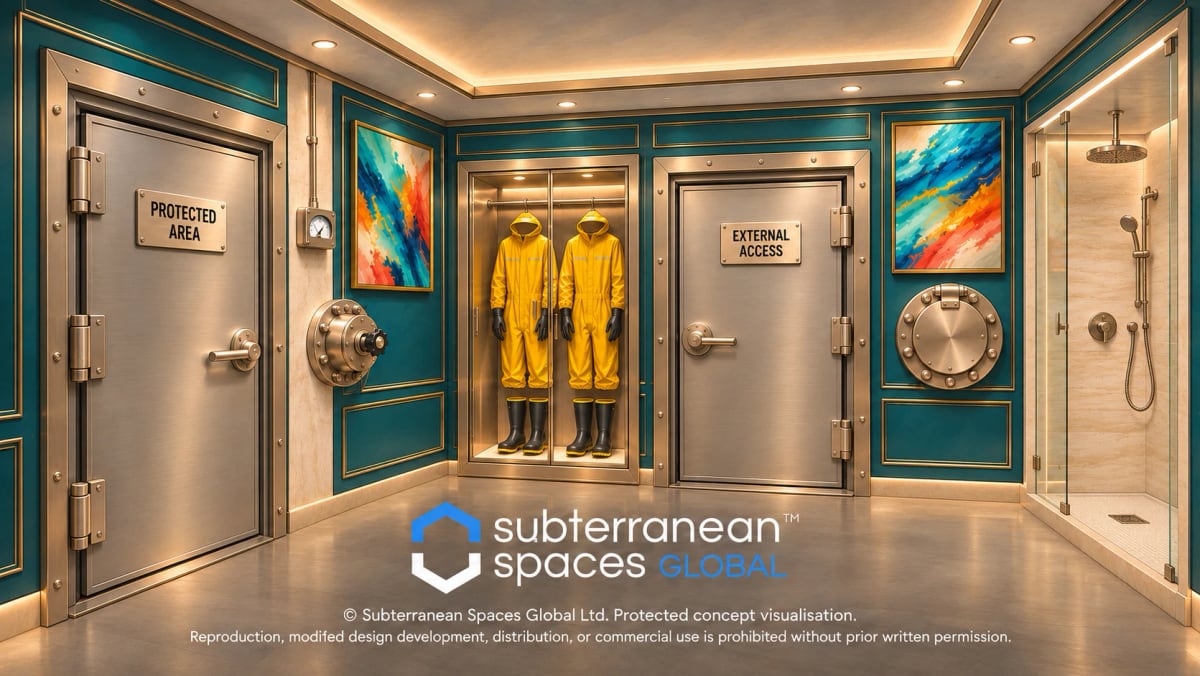
NBC Survival Bunkers need an entrance that supports the protection provided by their structure and life-support systems. Every arrival creates a connection with the outside environment, potentially bringing contaminated air, clothing or equipment towards the occupied space.
At Subterranean Spaces Global, we consider that transition from the earliest stages of design. An airlock provides a controlled space between the external environment and the protected accommodation, allowing entry and exit while helping to limit the movement of contamination.
Its effectiveness depends on the relationship between the chamber, its doors and the pressure-control components serving it.
Creating a controlled transition
A shelter airlock typically comprises a chamber between two doors, with each door operated separately. This avoids creating a direct open passage from outside into the occupied shelter.
In the arrangement discussed here, the occupied accommodation operates at a higher pressure than the airlock, which in turn operates above the external pressure. Under normal protective operation, with the doors closed, this creates a pressure cascade that encourages air to move outwards:
Protected accommodation → airlock → outside
A pressure-regulating valve at the internal boundary and a normally closed blast valve at the external boundary control this movement. A typical specification places a PRV 800 between the accommodation and airlock, with a BVNC valve between the airlock and outside.
The arrangement described here uses transfer and relief valves rather than dedicated airlock supply and extract ducts. The shelter’s filtered ventilation system still supplies the air and establishes the overpressure that drives this flow. The valves regulate and release that air; they do not generate pressure themselves. Source: Arconik, filtration systems
The PRV: regulating movement between compartments
The PRV controls air transfer across the internal boundary between the protected accommodation and the airlock.
A valve such as the PRV 800 regulates the pressure difference between adjoining compartments. Within this arrangement, it allows air from the higher-pressure accommodation to pass towards the lower-pressure airlock, helping maintain the intended pressure relationship.
Its selection must suit the complete shelter. The required performance depends on the available airflow, the compartments being served and the resistance of the onward path to outside.
The BVNC: controlled relief at the external boundary
BVNC stands for Blast Valve Normally Closed. It serves a different role at the airlock’s external boundary.
“Normally closed” does not mean that the valve remains shut throughout occupation. It opens when the internal pressure difference is sufficient to release air outwards, helping maintain the shelter’s overpressure. It is also designed to resist the inward passage of an external blast wave, subject to its specified performance.
The PRV therefore regulates transfer between internal spaces, while the BVNC combines outward pressure relief with blast protection at the external boundary. Source: Arconik, valve functions
Why opening a door changes the conditions
A pressure cascade provides a useful protective mechanism, but opening a door changes the airflow immediately. The movement of the door itself displaces air, and a person passing through the opening creates further disturbance.
Fontana and Quintino’s experimental research found that door operation could transfer contaminated air into a cleaner adjoining room despite an existing pressure difference. Within their tested conditions, the movement caused by the door remained an important influence on that transfer. Source: Fontana and Quintino, Building and Environment, 2014
Full-scale cleanroom experiments by Shao and colleagues also demonstrated particle transfer associated with people moving through a doorway. Source: Shao et al., Building and Environment, 2020
These studies concern controlled indoor environments such as operational underground centres rather than blast-resistant bunkers. Their relevance is the evidence they provide about door movement and contaminant transport. Applying those findings to a shelter requires assessment of its particular layout and operating conditions.
For SSG, this means considering what happens during an actual entry cycle, alongside the pressure relationship achieved when every door is closed.
Allowing the airlock to recover
After the external door closes, air passing from the protected accommodation through the airlock can help dilute and displace airborne contamination before the internal door opens. This process is commonly described as purging.
There is no universal waiting period for a bunker airlock to purge and the appropriate purge arrangements depend on chamber volume, airflow distribution, the anticipated contaminant and the required protective performance. However, this all plays a part in the controlled transition which SSG designs to ensure you are safe.
Air purging also serves a different purpose from removing contamination carried on clothing, footwear or equipment. Where those hazards are anticipated, the entrance needs suitable decontamination provisions and procedures alongside its pressure-control system. Source: US Department of Defense, CBR protection guidance, 2008, Appendix C
Designing the entrance around its occupants
An airlock must accommodate the people who will use it and the circumstances in which they may arrive. Protective clothing, carried supplies, assisted access and repeated entry all influence the space and its operation.
The detailed design brings those needs together with door performance, valve selection, pressure monitoring, maintenance access and the shelter’s available ventilation capacity. Commissioning must then verify that the installed arrangement performs as intended, including during door operation.
At Subterranean Spaces Global, we develop the entrance alongside the structure, filtration and essential services. This allows the airlock to support the same protective objectives as the accommodation beyond it, with an operating procedure that occupants can understand and follow.
If you are planning an NBC survival bunker or a clean underground operational centre, our design & consultancy team can assess how controlled access and pressure management should be incorporated into a design tailored to your site, occupancy and protection requirements.
Why Choose Subterranean Spaces Global?
With over 25 years of experience, Subterranean Spaces Global delivers advanced underground environments for private, commercial and specialist clients worldwide. Our expertise spans from luxury bunkers and asset security to protected spaces for commercial operations and multi-level facilities. We offer bespoke solutions tailored to your specific needs, backed by a legacy of technical excellence and innovative design.
Each project is tailored to the client's site, risk profile and long-term resilience goals, combining hardened structural engineering, specialist life-support systems, secure access, technical infrastructure and refined interior design.

Ready to Build Your Subterranean Space?
Whether you have an idea or a vision to discuss, or a project you are ready to embark on, get in touch.

Quotations are priced based on country and location
SUBTERRANEAN SPACES GLOBAL

LONDON
The Foundry, 77 Fulham Palace Road, London W6 8JA. UK
Tel: +44 203 026 5088

NEW YORK
99 Wall Street 5568, New York, NY 10005. USA
Tel: +1 332 208 0066
LOS ANGELES
2355 Westwood Boulevard #1820 Los Angeles CA 90064-2109. USA
Tel: +1 213 329-3255