
Independent by Design
Renewable Energy and Material Innovation at Subterranean Spaces Global
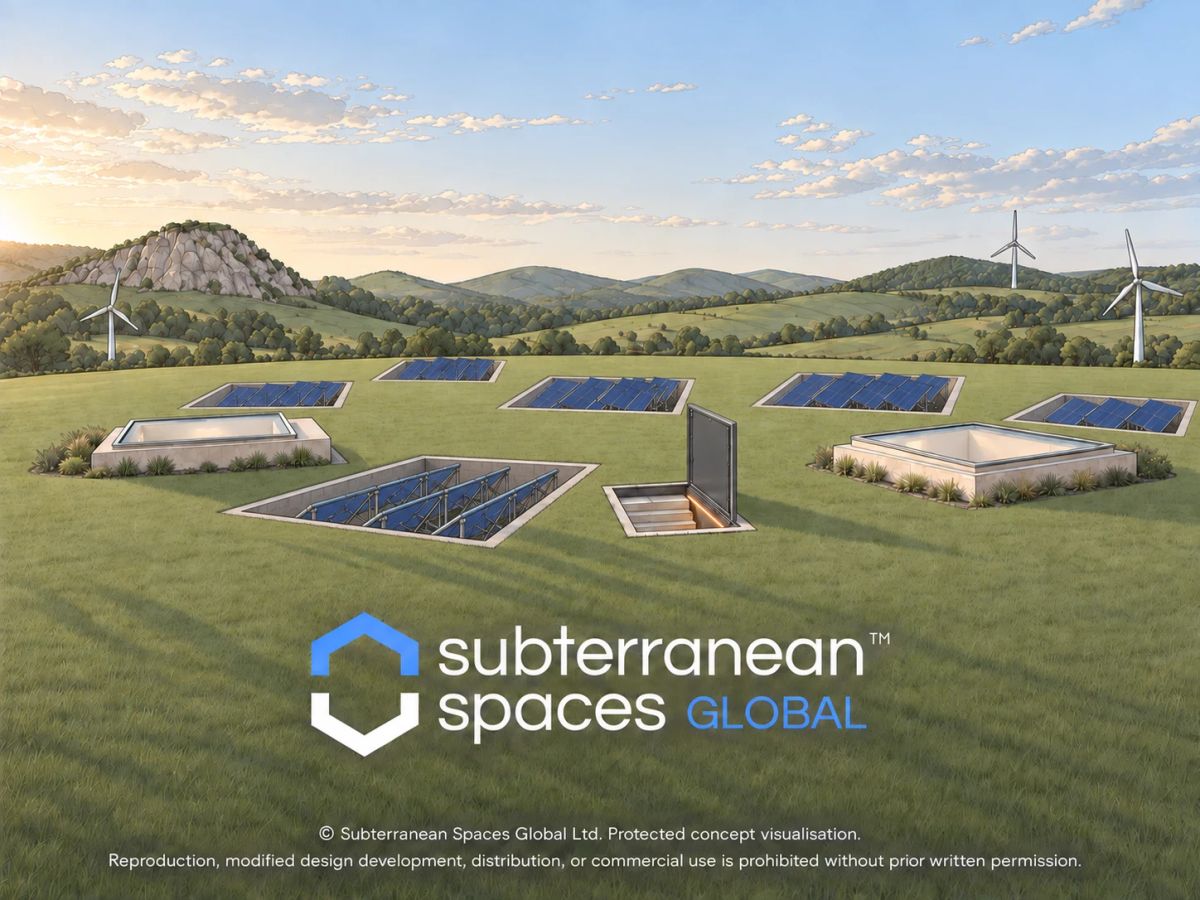
An underground space needs to work as a complete property. Its structure, layout, power, water and air systems all have to support the way it will be used. At Subterranean Spaces Global, this is where our approach to off-grid design begins.
From underground pods to climate-protected residences, renewable energy can reduce dependence on external infrastructure, but installing generation equipment is only part of the work. The space must remain practical to occupy, maintain and operate, including when sunlight is limited, wind conditions change or equipment needs attention.
We bring these considerations into the design from the outset, balancing the opportunities of new technology with the evidence needed to use it confidently.
Designing around everyday use
A permanently occupied underground home has different demands from an emergency shelter or a commercial facility. Before considering solar panels, turbines or batteries, we need to understand what will happen inside the space.
For underground living, comfort and everyday routines shape design. Underground data centres are designed to focus attention to power continuity and cooling, while underground operational centres look at sustaining communications and essential equipment for extended periods. Looking at the function of the space is vital to understanding which energy system and which materials are best fitted within.
Ventilation, filtration, water treatment, drainage and temperature control all consume electricity and they are essential for all such spaces. Whilst some systems must run continuously; others can operate at times when more energy is available. Understanding those differences helps us establish realistic electrical loads and decide how generation and storage should support them.
For SSG, all these decisions belong together. The structure and its services should be developed around the same expectations for occupancy, comfort and independence.
Choosing solar for the years ahead
Photovoltaic panels can provide a substantial share of a property’s electricity where the site is suitable. Ground-mounted arrays, canopies and associated buildings offer ways to incorporate solar generation into the wider grounds of an underground property.
The important question is how much useful electricity the installation will deliver over time. Shading, seasonal sunlight, temperature and ageing all affect that calculation.
Researchers Dirk Jordan and Sarah Kurtz put the point directly: “Degradation rates must be known in order to predict power delivery.” Their review which found a median degradation rate of approximately 0.5% per year influences the way we approach solar within the design. For an SSG project, this means looking beyond output at installation. We consider whether the system will continue to support the property as it ages, particularly during less favourable seasons. Source: Jordan and Kurtz, Progress in Photovoltaics
New photovoltaic materials are also worth examining. Perovskite–silicon tandem cells offer the prospect of greater efficiency, which could be valuable where installation space is limited. However, it’s been noted that unsolved issues in perovskite stability have important implications for real-world energy yields within properties. Such an observation reflects a wider consideration in our work: promising performance needs to be supported by evidence of durability under the conditions at the client’s property. Source: Duan et al., Nature Reviews Materials
Finding the right place for wind
A wind turbine can complement solar generation where local conditions make it worthwhile. Connected with batteries and the property’s electrical systems, these sources can form a property microgrid: a local network that coordinates generation, storage and consumption.
The contribution from wind needs careful assessment. Turbine height, blade design and materials, terrain, nearby buildings and trees can affect output or mechanical loading. Historical wind records help establish likely production, while potential changes in climate can inform the assessment of longer-term uncertainty.
The US Department of Energy identified turbulence around obstacles as a particular concern for small wind systems. Disturbed airflow can reduce production and increase loading on the turbine. A property that feels windy at ground level may therefore offer quite different conditions at the proposed turbine location and height. Source: Department of Energy, Small Wind Guidebook
At SSG, we consider how the installation relates to the underground building. Foundations, cable routes and access for servicing need to be planned without compromising the structure or waterproofing. Maintenance should be straightforward, and the equipment should fit the way the property is used. Our aim is to make living underground as convenient as living above ground, even if there is no grid connection.
Keeping essential services running
Storage and controls manage the gaps between renewable generation and demand. For independent operation, the microgrid also needs equipment capable of maintaining voltage and frequency as conditions change.
Battery capacity must be considered against a defined period of use. How long must ventilation, water systems and other essential equipment remain available with little renewable generation? How quickly can the batteries recharge afterwards? Does the property need a backup generator?
In nuclear bunker construction, these questions form part of a wider assessment of protective requirements and the period for which the facility must support its occupants. Bunker builders and specialist engineers need to coordinate the structure, energy supply and essential services around those requirements.
These questions establish what “off-grid” means for the particular project. They also help owners understand the system’s capabilities and the operating decisions that may be needed during an extended shortage.
Making considered use of new materials
Our interest in new materials follows the same approach. Alternative concrete formulations, advanced insulation, composites and waterproofing products may offer worthwhile improvements, but each needs to be assessed for its intended application.
A newer material is not necessarily the safest choice. Strength, weight or insulation performance may be attractive, while other characteristics make it unsuitable for a particular structural or protective role.
SSG explores how emerging materials can be incorporated alongside established solutions where the evidence supports their use. This includes examining how the materials behave together. Their chemical, physical and mechanical interactions must not compromise the safety or durability of the completed structure.
Some problems at material interfaces take years to become visible. Moisture, electrical contact, temperature changes and different rates of movement can all affect performance. Product compatibility, installation requirements and long-term exposure therefore need attention before materials are specified.
We assess the assembly as a whole, including its loads, groundwater exposure, fire performance, ductility and maintenance requirements. A component must perform its own role while remaining compatible with everything around it.
This is the basis of our approach to both renewable energy and material innovation. We want the benefits that new developments can offer, supported by the engineering needed to make them dependable in an underground setting.
Why Choose Subterranean Spaces Global?
With over 25 years of experience, Subterranean Spaces Global delivers advanced underground environments for private, commercial and specialist clients worldwide. Our expertise spans from luxury bunkers and asset security to protected spaces for commercial operations and multi-level facilities. We offer bespoke solutions tailored to your specific needs, backed by a legacy of technical excellence and innovative design.
Each project is tailored to the client's site, risk profile and long-term resilience goals, combining hardened structural engineering, specialist life-support systems, secure access, technical infrastructure and refined interior design.

Ready to Build Your Subterranean Space?
Whether you have an idea or a vision to discuss, or a project you are ready to embark on, get in touch.

Quotations are priced based on country and location
SUBTERRANEAN SPACES GLOBAL

LONDON
The Foundry, 77 Fulham Palace Road, London W6 8JA. UK
Tel: +44 203 026 5088

NEW YORK
99 Wall Street 5568, New York, NY 10005. USA
Tel: +1 332 208 0066
LOS ANGELES
2355 Westwood Boulevard #1820 Los Angeles CA 90064-2109. USA
Tel: +1 213 329-3255