
Managing Waste During Extended Underground Autonomy
Separation, compaction and containment in an NBC survival bunker
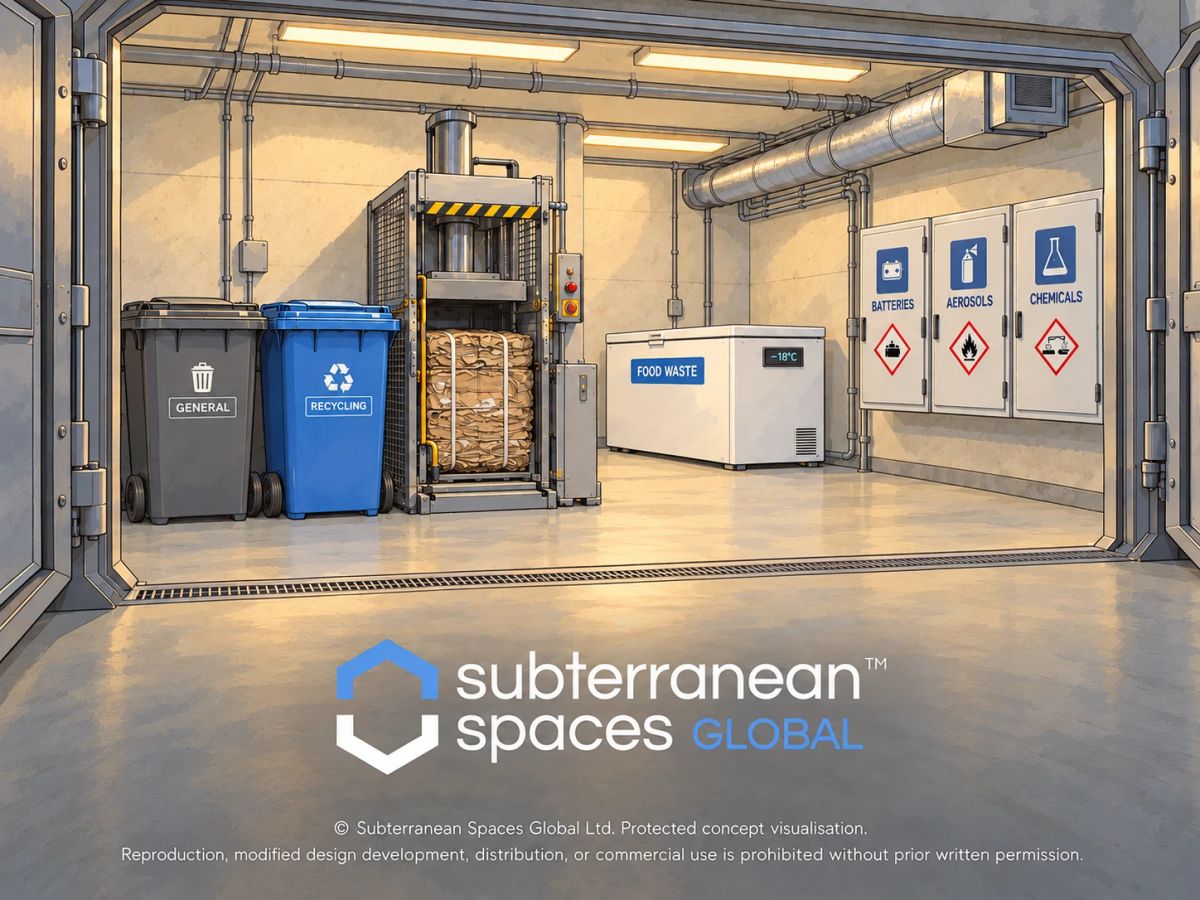
An underground shelter must protect its occupants from the hazards outside while managing those that develop within. In an NBC (Nuclear, Biological, Chemical) Survival Bunker, everyday waste becomes part of that responsibility. Food scraps, packaging and discarded batteries all need somewhere safe to go when leaving the shelter is not an option.
At Subterranean Spaces Global, our proposed approach in nuclear construction and design for extended occupancy is to separate, compact and securely retain waste until safe removal becomes possible.
Whilst incineration is an option for underground waste removal, it cannot be forgotten that it introduces a highly intensive heat process into a confined occupied underground environment. For context, regulated waste-incineration systems commonly require combustion gases to reach at least 850°C. Although this is a gas-treatment condition, rather than the incinerator’s external surface temperature, it shows the scale of heat that could exist within your protected environment, which we consider an unnecessary risk.
Heat protection, combustion air, fire separation, ash handling and controlled exhaust treatment all require consideration when integrating incinerators into the home. Hazardous combustion products cannot simply be vented outside without assessing emissions and potential re-entry into air intakes.
For six occupants over 42 days, SSG’s working allowance is 260 kg of ordinary solid waste— approximately 1 kg per person per day. Rather than opting for the incinerator route, we propose a 4–5 m² waste room to accommodate three distinct streams which are explained below.
Note: these figures are subject to verification of storage capacity, equipment clearances and safe access.
1. Compact Everyday Waste
Stream one is made from two 240-litre bins which separate general compressible waste from dry packaging and recyclables. In order to ensure the smallest spaces possible, we propose using a QCR compactor to achieve approximately a 3:1 volume reduction on average, with up to 5:1 volume reduction depending on the waste material. Although compaction reduces volume, and not mass, bin weight limits still apply and batteries, aerosols, glass and other prohibited materials must stay out of the compactor.
Source: QCR specifications
2. Freeze Food Waste
Stream two is a dedicated 400–500-litre freezer to hold food waste in labelled, leak-resistant bags or containers. Storage at approximately −18°C suppresses microbial growth enough to prevent contamination outside the bags in extended autonomy. Although, this process does not prevent sterilisation, the design must ensure backup power, temperature alarms and a freezer-failure procedure are present to prevent microbial growth and smell if stream two fails. Our freezer selection also considers the refrigerant’s flammability, ventilation, ignition risks and heat injected into the room.
3. Isolate Hazardous Items
In terms of hazardous items such as batteries, aerosols and chemical residues, these would require labelled storage selected for their individual hazards. An in-built, multi-compartmental wall cabinet would ensure safe separation and storage aligning with each hazard.
It must be remembered that stored waste still remains a combustible load so although the incinerator may be excluded, fire risks remain present. Therefore, the waste room is designed to include a coordinated fire strategy, cleanable surfaces, spill containment and protected escape routes. Its air-handling arrangements are largely separated to control odours and contaminants externally without compromising the shelter’s protective pressure relationships.
Source: WBDG
Before finalising the layout, waste volumes, usable freezer capacity and contingency storage must be verified against the intended supplies and occupancy. Please note that sewage, clinical waste and CBRN-contaminated materials require separate provisions.
SSG’s roots in protective technology shape this approach: protection includes the everyday systems that keep a space safe, habitable and manageable throughout its period of autonomy.
Why Choose Subterranean Spaces Global?
With over 25 years of experience, Subterranean Spaces Global delivers advanced underground environments for private, commercial and specialist clients worldwide. Our expertise spans from luxury bunkers and asset security to protected spaces for commercial operations and multi-level facilities. We offer bespoke solutions tailored to your specific needs, backed by a legacy of technical excellence and innovative design.
Each project is tailored to the client's site, risk profile and long-term resilience goals, combining hardened structural engineering, specialist life-support systems, secure access, technical infrastructure and refined interior design.

Ready to Build Your Subterranean Space?
Whether you have an idea or a vision to discuss, or a project you are ready to embark on, get in touch.

Quotations are priced based on country and location
SUBTERRANEAN SPACES GLOBAL

LONDON
The Foundry, 77 Fulham Palace Road, London W6 8JA. UK
Tel: +44 203 026 5088

NEW YORK
99 Wall Street 5568, New York, NY 10005. USA
Tel: +1 332 208 0066
LOS ANGELES
2355 Westwood Boulevard #1820 Los Angeles CA 90064-2109. USA
Tel: +1 213 329-3255