
Determining the Right Level of Bunker Protection
How location, blast exposure and independence shape our CBRN and NBC bunker specifications
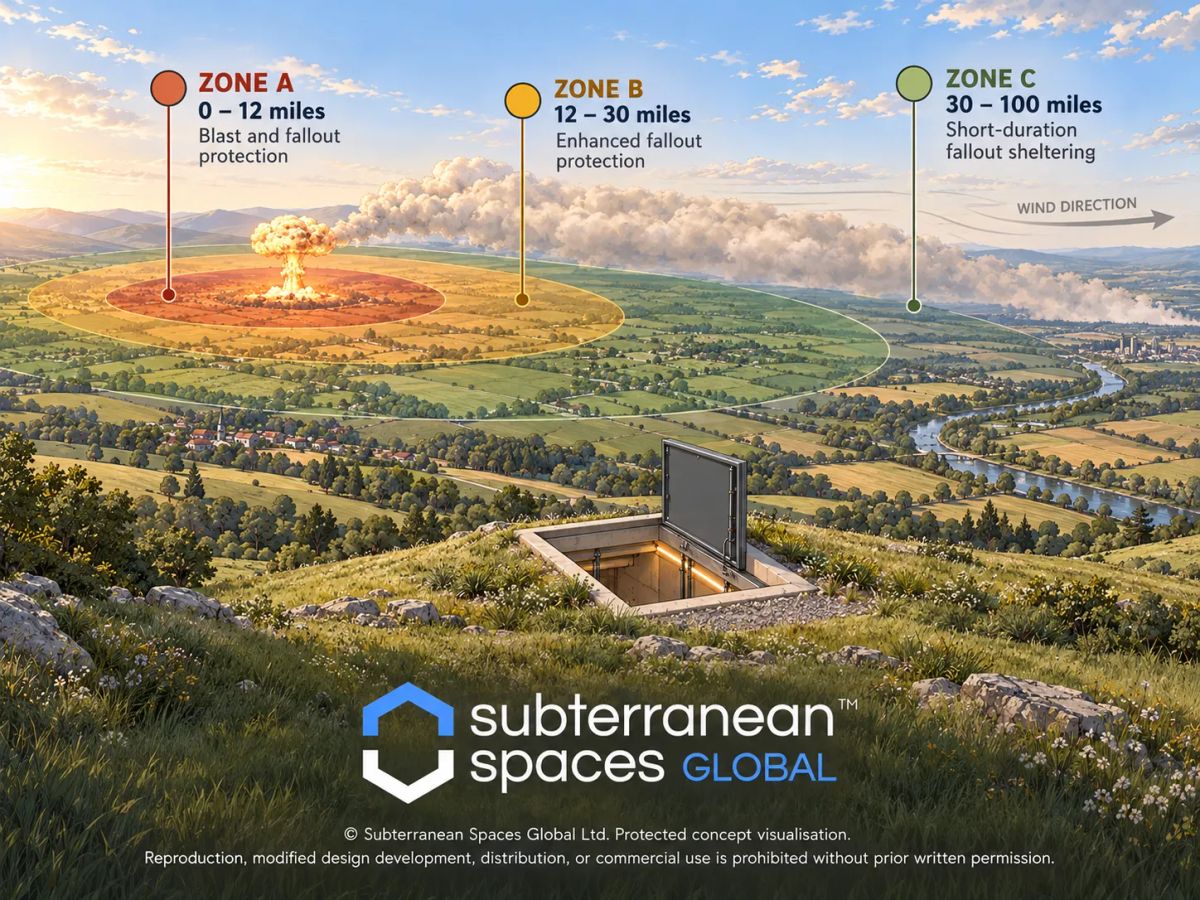
When enquiring about a protective underground bunker, one of the first questions is how much protection your property needs. The answer involves understanding the hazards the shelter may face, how these could affect its occupants and how long essential services must operate independently.
At Subterranean Spaces Global, our zoning strategy provides a starting point for that assessment. Across three categories, we distinguish between combined blast and fallout protection, enhanced fallout protection with lower blast-loading requirements, and short-duration fallout sheltering.
Each specification brings together the structure, protective systems and provisions needed for its intended role.
Starting with the property and its surroundings
Our assessment begins with the location, intended occupancy and the client’s resilience requirements. We consider proximity to potential strategic sites, including military facilities, major transport infrastructure and urban centres, alongside ground conditions, access and dependence on external services.
For the nuclear component of CBRN protection, distance from a potential detonation is relevant, but it cannot determine the specification alone. Weapon yield, burst height, terrain and weather influence the effects experienced at a property. Sandia National Laboratories emphasises that generic nuclear-effects estimates cannot replace analysis of a specific scenario. Source: Sandia National Laboratories.
At Subterranean Spaces Global, we use a 200-kiloton above-ground nuclear detonation as a reference scenario for our initial blast assessments, allowing us to examine a higher-yield event before refining the specification around the individual site. For comparison, the Swedish Radiation Safety Authority selected a 100-kiloton ground-level detonation as the principal scenario in its fallout study. Our 200-kiloton reference should therefore be understood as a conservative starting point for blast assessment, with fallout requiring separate consideration of burst conditions, wind and weather. Source: Swedish Radiation Safety Authority.
How radiation and fallout change with distance
The immediate radiation released by a detonation and the radiation subsequently emitted by fallout behave differently. Direct radiation generally diminishes with increasing distance through geometric spreading and attenuation in the atmosphere. Fallout, however, consists of radioactive particles transported through the air before settling on land and buildings. Larger particles tend to settle nearer the detonation, while finer material can travel much farther. Increasing distance can therefore reduce exposure in comparable conditions, but fallout concentration does not decline evenly in every direction. Wind carries the plume, and rainfall can produce concentrated deposits. A property farther away beneath that plume may experience greater contamination than a closer property outside it. There is no reliable rule that doubling the distance quarters the fallout hazard. Once material settles nearby, its location and activity determine exposure, making shielding and local radiation measurements essential. Source: HHS Radiation Emergency Medical Management
This explains why fallout protection remains relevant well beyond areas of serious blast damage. The Swedish Radiation Safety Authority identifies a need to plan for radiological consequences at distances extending to hundreds of kilometres in some scenarios. Source: Swedish Radiation Safety Authority
How the blast wave affects the pressure envelope
A nuclear detonation produces a rapidly expanding shock wave that travels outwards from the explosion, initially faster than sound. At a property, its arrival causes a sudden rise above normal atmospheric pressure, accompanied by powerful air movement. Pressure subsequently falls, and a negative-pressure phase can follow. Blast severity generally decreases with distance, although reflections from the ground, buildings and terrain complicate local loading. FEMA’s guidance consequently treats damage boundaries as variable rather than sharply defined circles. Source: FEMA nuclear detonation planning guidance
For engineering purposes, peak pressure is only part of the assessment. The duration of loading and its impulse (the pressure accumulated over time) also affect structural response. A pressure rating must therefore relate to defined loading conditions.
This is why our specifications have different requirements for their protective pressure envelope: the connected boundary formed by the structure, doors, hatches and service penetrations. Zone A requires a higher blast-protection specification; Zone B addresses lower overpressure conditions; Zone C is specified for fallout protection without blast resistance.
Understanding our three assessment zones
Zone A — combined blast and fallout protection
Our initial Zone A catchment covers locations within approximately 12 miles of an assumed detonation point.
Here, the assessment gives particular attention to combined blast loading, contamination and potentially prolonged infrastructure disruption. Our Safe Haven specification provides for approximately two to six weeks of self-contained occupancy, with a reinforced, ductile structure and coordinated pressure-resistant components.
Filtered ventilation, stored water, independent power and waste management support that extended occupation. The 12-mile band prompts this higher level of assessment; it does not imply that one specification withstands every possible detonation anywhere within it.
Zone B — enhanced fallout protection
Zone B covers an initial assessment band of approximately 12–30 miles.
Its purpose is to address locations where fallout and service interruption may dominate, while retaining protection against lower blast overpressures. The enhanced specification provides approximately ten days of independent operation, with backup generation and essential life-support systems.
Whether blast loading is sufficiently low for this category must still be checked against the assumed event. Crossing the 12-mile boundary does not automatically remove the need for substantial blast protection.
Zone C — short-duration fallout sheltering
Zone C covers approximately 30–100 miles as an initial assessment band.
This specification focuses on radiation shielding, controlled ventilation and essential provisions for up to approximately 48 hours, without a blast-resistant structural specification.
The organising logic across these bands is the changing balance between immediate structural hazards and wider contamination or infrastructure disruption. They are SSG assessment categories, rather than universal scientific boundaries. Neither the 100-mile limit nor the planned occupancy duration establishes when an affected location becomes safe but it helps towards making informed decisions when designing a bespoke NBC survival bunker.
Protecting connections to the outside environment
The pressure envelope must account for technical infrastructure exposed to external conditions. Air intakes, ventilation outlets, generator exhausts and tank or drainage vents can provide routes for pressure transmission.
Where blast protection is required, suitable blast valves rapidly restrict the pressure wave entering through those pathways. Selection must match the expected loading, airflow and service conditions. Generator exhausts, for example, require components suited to hot exhaust gases; sanitary and tank vents have different operating requirements. Source: Temet protective systems
Pressure regulation serves a separate purpose. Filtered ventilation can maintain a modest positive internal pressure to reduce inward leakage, while an overpressure relief valve controls outgoing air. That everyday pressure differential is distinct from the much larger transient pressure of a blast. A relief valve must have a suitable blast rating, or separate protection, wherever the design requires it.
Turning the assessment into a specification
Our zoning strategy helps establish the questions that detailed design must resolve. The final recommendation brings together location, credible hazards, structural loading, shielding and the resources needed for the agreed occupancy.
Air filtration controls airborne contaminants; shielding reduces exposure to penetrating radiation. Independent power, water and sanitation make continued occupation practical. Each must support the same protective objective.
The agreed autonomy period describes the shelter’s capacity. Decisions about leaving it must respond to actual conditions provided by external sensors, cameras, radiation monitoring and official instructions. Source: UK Government radiation emergency guidance
For SSG, determining the right protection means developing a complete underground environment around the property and for the people who will depend on it.
Why Choose Subterranean Spaces Global?
With over 25 years of experience, Subterranean Spaces Global delivers advanced underground environments for private, commercial and specialist clients worldwide. Our expertise spans from luxury bunkers and asset security to protected spaces for commercial operations and multi-level facilities. We offer bespoke solutions tailored to your specific needs, backed by a legacy of technical excellence and innovative design.
Each project is tailored to the client's site, risk profile and long-term resilience goals, combining hardened structural engineering, specialist life-support systems, secure access, technical infrastructure and refined interior design.

Ready to Build Your Subterranean Space?
Whether you have an idea or a vision to discuss, or a project you are ready to embark on, get in touch.

Quotations are priced based on country and location
SUBTERRANEAN SPACES GLOBAL

LONDON
The Foundry, 77 Fulham Palace Road, London W6 8JA. UK
Tel: +44 203 026 5088

NEW YORK
99 Wall Street 5568, New York, NY 10005. USA
Tel: +1 332 208 0066
LOS ANGELES
2355 Westwood Boulevard #1820 Los Angeles CA 90064-2109. USA
Tel: +1 213 329-3255
